Science is not always hard. With school physics and a powerful amplifier even a light bulb can be a speaker. And a reasonably coherent one, even if not loud.
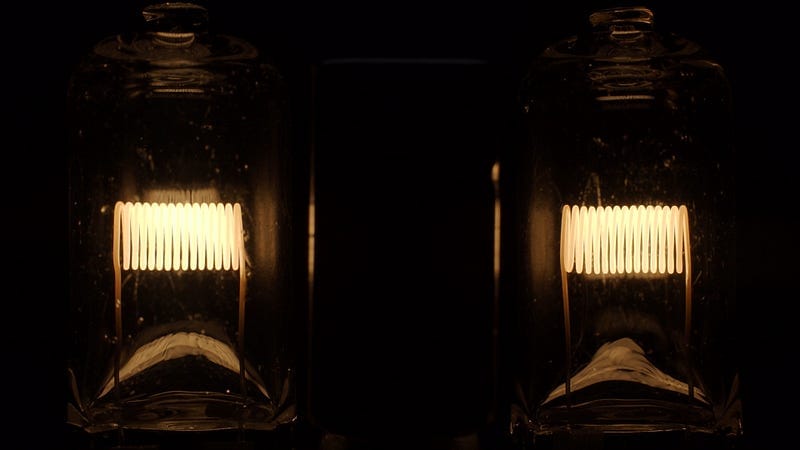
Music played through halogen bulbs.
This story started about 10 years ago when Denis Mokhov kickstarted a quantum levitation set. “Buy a superconductor online” — how could I resist? That was the best money I’ve spent, and the most valuable part for me was not the set but a training session that came with it. We played with liquid nitrogen, sulphur hexafluoride (the opposite of helium, makes voice really low. Also kind of disables electroshockers and allows paper boats to float in the air)…
One of the experiments was surprisingly simple: stick a wire mess (coil is best, but a tangled mess works fine and looks funnier) to a sheet of paper with sellotape, plug it into an amplifier and put a magnet in the center. This makes a surprisingly good and loud speaker (until sellotape melts). No Hi-Fi by any means, but it sounds way better than one would expect from a pile of junk. How speakers are made is basic school material, yet seeing that live has a Clarke kind of magic vibe.
Note of caution: amplifiers may not like very low resistance of such makeshift speaker. Only do it with an amp you can afford to burn.
Recently I was recreating this setup and short circuit protection was tripping, so I’ve added a light bulb as a resistor to pacify it. Idea: what if ̶a̶l̶l̶ ̶w̶e̶ ̶n̶e̶e̶d̶ ̶i̶s̶ ̶b̶u̶l̶b̶ bulb itself can be the coil?
That started my build quest: I got 250 W halogen bulbs, a supposedly 1.8 kW amplifier on Aliexpress, an audio-grade power supply (makes speaker hum and its transformer whines like a mouse), large capacitors and epoxy (to silence the rodent-power supply), another amplifier (I’ve mentioned that they may not like low Ω speakers?), 1 Ω 80 W resistor array (to avoid buying one more amp), an acrylic case (we are in the danger-voltage zone with plenty of current delivery capacity) and a foot pedal (for extra safety).
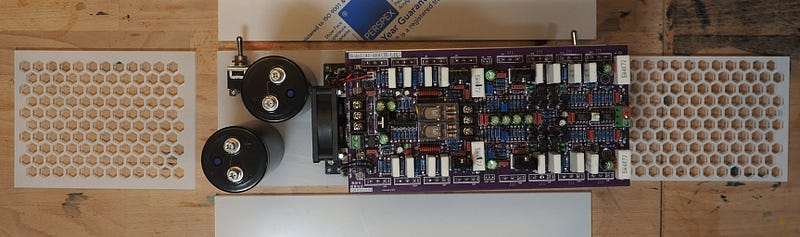
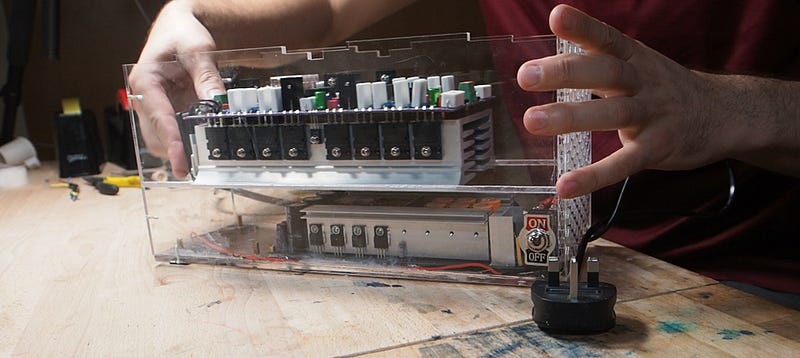
And the final result, or rather an intermediate one — the road to perfection is endless:
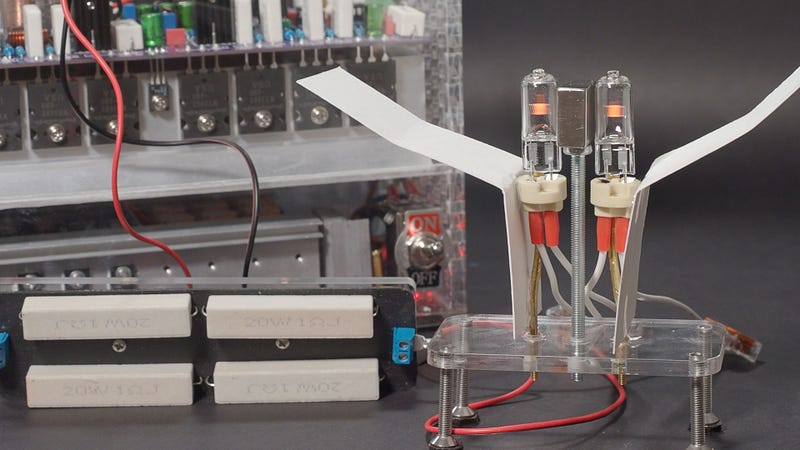
Key insights:
- Be considerate: if you plan to repeat the experiments, either stick to a safe 12V voltage or take appropriate safety measures. Also, don’t use your beloved Hi-Fi amplifier: there is a chance that it will burn.
- With enough power, anything will start making sounds. Floppotron is my favorite.
- No magnet — no disco. I’m not the first to plug a bulb into an amp. But in 2 other videos that I’ve found people could only swear that they heard something if they put an ear close to the bulb. Without a magnetic field the sound will be very faint.
- Halogen bulbs allow placing the magnet closer to the filament.
- Adding a horn helps transferring vibrations to the air. Most observant readers may notice that it is placed wrong: perpendicular to vibrations. Initially it was flat and vertical, but then I sacrificed loudness for artistic appearance.
- A series resistor is a waste of power, but it reduces 5x Ω variance between cold/hot filament and keeps that magic smoke, on which all electronics run, inside.
- Run time — up to 2 minutes. After that amplifier overheats and needs active cooling which interferes with the sound recording. And I can’t put the amp away because it is part of the installation, it needs to be in the frame.
- The filament resistance increases 5x when hot. Its plasticity changes a lot too.
The last point is interesting: cold bulbs sound like a rusty old robot, but hot filament doesn’t have those metallic aberrations. So I had to preheat it. DC current would be the best, but regular audio devices can’t do that: not optimized for my warm tube sound system, I guess. So I had to use a 10Hz subtone instead. Harmonics from it are mostly inaudible, but video sequence captures these “parasitic” oscillations. Anyway, it only matters for voice. Modern music is optimized for the underground (in the UK) or car (in the US) listening. It needs to be uniformly loud to be heard through the ambient noise. So music can be played on the bulb setup without modifications.
Now you’ve heard what “warm tube sound” is.
P.S. What I enjoyed most in the project is that while it is based on very basic school physics, there are many parameters to change and they give immediate feedback. What is the best magnet/bulb orientation? Stronger magnet? Does horn help? Preheat? Make bulb support flexible? Are bulbs in phase or counter-phase? It was a very researchy, iterative process and it delivered reward at every step.